
What Companies Think AI Wants vs What Actually Works
Most companies are still writing for Google 2015, while their customers are already living in AI 2026.
3/12/20263 min read
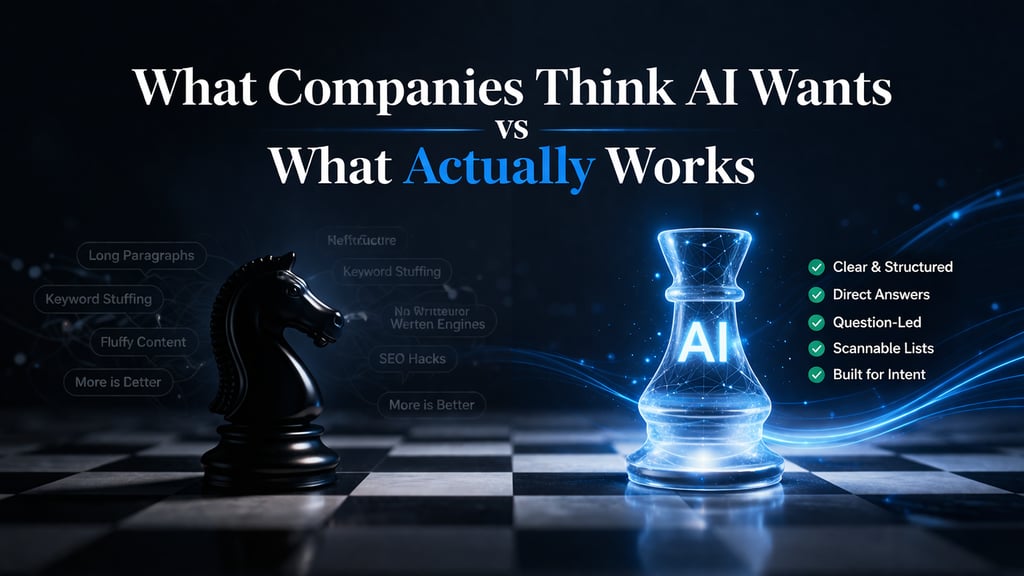

AI is not just looking for keywords or more content anymore. It is looking for clear meaning.
That means your content should not feel like a long wall of text. It should be easy to scan, well structured, easy to understand, and easy to reuse in answers.
The smartest way to structure content now is:
So what actually works?
Step 1: Start with the real question
Write the exact question your audience would ask.
Examples:
What is the best CRM for a small business?
How do I reduce cart abandonment?
Should I use a chatbot or live agent?
This matters because users are changing how they search. More of them now ask full questions and expect direct answers, not ten blue links. Adobe’s 2026 AI and Digital Trends research shows AI is reshaping customer experience across discovery, support, and purchase journeys, while its consumer study shows customer behavior around AI is shifting but still depends heavily on trust and comfort levels.
Step 2: Answer it directly
Give the short answer first. Then explain it in simple language. That helps both people and AI systems understand your point fast.
Example format:
Question: Should a business use AI chatbots for customer support?
Answer: Yes, but only for simple and repeated questions first.
Then explain why.
This fits what strong AI-driven service design is showing in 2026: leaders are getting better results not by adding random AI tools, but by redesigning journeys and matching AI to the right tasks.
Step 3: Turn big ideas into listicles and suggestions
After the answer, break the topic into a simple list.
Examples:
3 signs your chatbot is hurting customer experience
5 questions to ask before automating support
Best options for first-stage AI automation
Why this works: lists reduce confusion. They make the content easier to scan, compare, and quote.
Step 4: Show how you would solve it
Do not stop at theory. Add a section like this:
How I would solve it:
Pick the top 5 customer questions.
Separate simple questions from complex ones.
Automate the simple ones first.
Add human handoff for risky or emotional cases.
Track where customers still get stuck.
Improve the flow every month.
This is where many companies go wrong. They think AI fails because the model is weak. In real execution, failure usually comes from bad workflow design, poor data, weak handoff, or lack of guardrails. That is also the core message in your draft. IBM’s 2026 guidance says common AI integration barriers include poor data quality, lack of expertise, high cost, and bias or hallucinations.
Step 5: Build around this flow
Intent → Journey → Automation → Feedback loop
This is the structure companies should follow.
Intent
What is the user actually trying to do?
Journey
What steps do they take from question to result?
Automation
Which steps are safe, repeatable, and low-risk enough for AI to handle?
Feedback loop
Where did the user get confused, drop off, or ask for a human?
This matters because AI works best when the task is clear and bounded. Salesforce’s 2026 contact center launch emphasized that AI is moving from answering questions to taking action, but only inside unified systems with strong context. Their leadership content also says managers now need visibility into where AI is breaking and where handoffs fail.
What companies think vs what is actually happening?
What companies think:
“If we add AI to the website, customer service will become smarter.”
What is actually happening:
AI only works well when the journey is redesigned, the knowledge is clean, and the handoff to humans is built properly.
What companies think:
“Lower call volume means success.”
What is actually happening:
Deflection is not the same as solving the problem. If the issue is not resolved, customers leave frustrated. Salesforce’s 2026 guidance says leaders should measure where the system breaks, not just how much work AI absorbs.
What companies think:
“AI will replace people.”
What is actually happening:
The strongest model is human + AI together. McKinsey’s 2026 research says organizations are moving toward collaboration between human employees and AI agents, not simple replacement. Salesforce’s 2026 C-suite research similarly found most executives expect humans and AI agents to work together.
Step 7: Show the user behavior shift clearly
People are no longer only searching. They are:
asking
comparing
validating
expecting suggestions
wanting the answer in one place
This means your content must evolve. Not just for ranking, but for understanding and decision-making.
Google’s guidance still stresses helpful, original content and valid structured data, while Adobe’s LLM-related product and commerce guidance reflects the shift toward AI-driven discovery, zero-click behavior, and question-led experiences.
Final Thought
The future of content is not about being found. It’s about being understood. The brands that win won’t be the ones with the most content but the ones whose content is:
Clear
Structured
Actionable
Built for real human intent
Because in the AI era, if your content can’t be understood, it won’t be used.
AI Search Pivot Playbook
Join the Insider List
© 2026. All rights reserved AI Search Pivot Playbook